
As I sit at the airport lounge waiting to board, I can’t help but notice five-year-olds gawking at their iPads. No one is bored. No bouts of laughter or silliness or annoyance. It is disturbingly serene. Our flights are two hours delayed, but no one is irritated. We are all numbing ourselves. Ages five to fifty. We don’t want to feel or express or confront. There is a brain fog.
Nobody dares to say hello to the person sitting beside, and I question what is this about. Are we all antisocial? Or are multibillion dollar tech-companies curating perfect online algorithms for us so that we don’t ask questions or register protests and constantly be too overwhelmed to even initiate a chat?
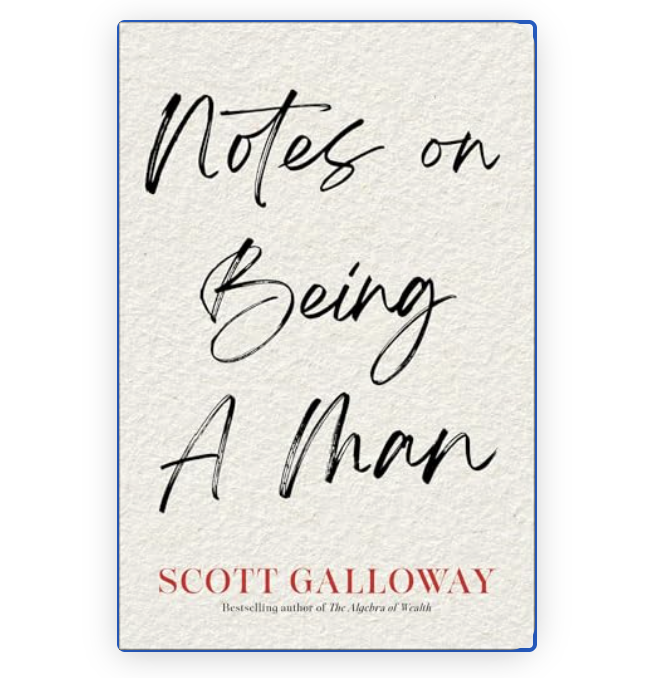
What Scott Galloway Says About Boys and Screens
A similar concern regarding adolescent boys is raised by professor, podcaster, and businessman Scott Galloway in his recent book Notes on Being a Man. Galloway’s book is part memoir and part self-help. Having laid out the challenges that young boys face in this economy, he also emphasises the remedies and practices that parents and we, as a society, can take to raise a healthy, happy, and aware generation of young people. Galloway mentions that post-COVID, isolation has become more widely accepted than ever.
Not meeting friends, not leaving home, not taking risks, not engaging in physical sports, addictions have become the new-normal. He provides statistical data showing that 24% of teens are addicted to social media, which is leading to isolation and a rapid increase in mental health crisis among young people. It is this addiction to social media, which has increased the suicide rates to 56% in teens and young adults in the last decade. Galloway argues that ‘teens who are on social media for more than three hours a day are twice as likely to be anxious or depressed as those who are on for less than an hour.’
The Systems Behind the Screens
The Netflix documentary-drama The Social Dilemma highlights the deeply problematic use of personal data from social media apps, which helps them to monitor and dictate the algorithms of individual users and make them addicted. Tristan Harris, a technology ethicist and the co-founder of Centre for Humane Technology advocates for a systemic change in the way social media today has hijacked our ability to see and understand the world around us. Through his podcast Your Undivided Attention, he highlights how consumer attention is sold, manipulated, and abused by these trillion-dollar tech companies. Studies by other organisations, such as the UN, arguably conclude that the most profitable business models in the world treat human attention as a scarce resource and sell it as data in a market, allowing other businesses to manipulate users and sell their products and agendas.
Why “Attention” is the wrong word
Galloway posits that the “attention economy” is more accurately an addiction economy. Attention functions as a metric for addictive products— social media, technology, substances, video games, fast food, phones, and tablets—rather than as a neutral human faculty. The most valuable companies today do not merely capture attention; they convert dopamine into profit, or supply the tools that allow others to do so. In this system, craving becomes the primary engine of capitalism, manufacturing demand and sustaining irrational margins, with boys and young men emerging as the most vulnerable to its effects. Framed this way, the attention economy is not about information or engagement, but about the systematic extraction and monetisation of human desire—where attention is valuable precisely because it can be engineered into dependence.
What Young People Are Actually Saying
Conversations with young people reveal that they are increasingly hooked to social media (See below). Galloway draws on Jonathan Haidt and Richard Reeves (his Yoda, as he calls him), to consolidate his arguments.
“Even after turning my notifications off, knowing fully well that no one is going to text me, I still find myself lingering over my phone. ”
Soumya, 20
“ It is impossible for me to go outside my home without my headphones. My friends have pointed out that I am almost always wearing my earphones. I like listening to music when I am out and about my day, but I think it also has become a coping mechanism to avoid all possible interactions with people.”
Harris, 22
“I feel very scared about everything. Everyone is prettier, happier, more talented, richer, more creative. I like to watch dance videos and art videos. I wish to be like******* (an influencer) one day.”
Advika, 11
“For me, social media slowly became more distracting than helpful. What started as casual scrolling turned into constantly checking my phone for likes and notifications. I began comparing my life to what I saw online, even though I knew it wasn’t real. Over time, it affected my focus and how I saw myself. Instead of helping me connect or grow, social media just pulled my attention away and made me feel less present.”
Chirayu, 21
A Generation at Risk or an Economy Out of Control?
Galloway raises an important social and political concern that there is a whole generation of people at risk of addiction. He writes: ‘ If your son is in the basement vaping and playing video games, you don’t really care about trans athletes or territorial sovereignty in Ukraine; you just want change […]’. The increased health issues, unrealised potential in young people, failing relationships and friendships due to increased isolation are not just behavioural failures, but a byproduct of an economic system that is designed to exploit young children to make profits. We believe that humanity, and not just men, are dealing with a systemic crisis perpetuated by the business models in the attention economy; however, the most vulnerable are children and young people, who are not aware of the problem and need a community-level awareness and effort.
What Does It Mean to Be Human Now?
Galloway in the beginning of the book, talks about “what it means to be male.” He writes: “Men protect, provide, and procreate.” One might disagree with this kind of oversimplification and even argue against such a traditionalist view of masculinity. What I found particularly appealing in the book, however, is his ability to weave his life story and advice around this idea. Reading this book as a young woman, I couldn’t help but wonder what it means to be human in a time when society is growing more isolated, intolerant, and polarised by the day; when Instagram feeds and Pinterest mood boards increasingly stand in for personality; and when, in an age of “brain rot,” ChatGPT becomes our go-to rather than our next-door neighbour. And I conclude that to be humans is to create, not mindlessly consume, to debate in order to convey and understand, not to perpetuate hate, to evolve to be smarter and kinder and not dumber and intolerant, and to care radically for our children, for neighbours, for our friends and partners, and for the world.
This book pushes us to think about what can we as parents and educators do. What responsibilities do we, as lovers, friends, and citizens, share to keep each other in check and register our concerns about this engulfing phenomenon? Before we initiate a conversation about this with the young ones, what can we do about this addiction as adults?
Galloway mentions that “Central to the prosperity and survival of our species is mothers and fathers who have an irrational passion for their kids’ well-being….The world needs more engaged fathers, not a better […] phone.” (259). Being engaged with the world is contingent on reclaiming our own attention and wellbeing. This, as Galloway suggests, could be done by engaging in physical sports, being vulnerable with our loved ones, being in public spaces, and not isolating with our screens, and extending support and affection.
Shalini is a volunteer writer and part of the Power of Zero communications team.





Leave A Comment